

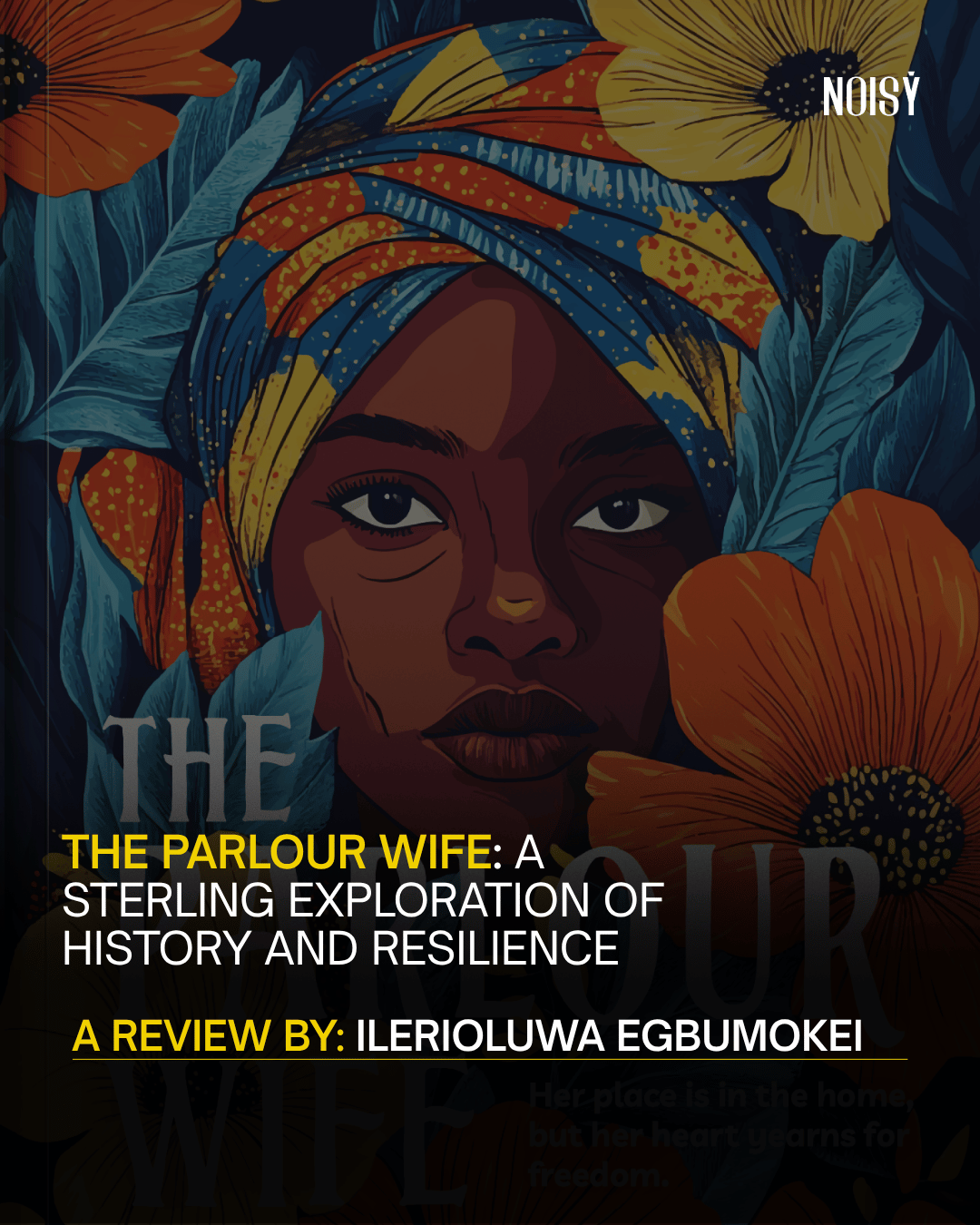

I once had a conversation with a friend about how Nigerian authors often return to the same haunting themes – war, poverty, and the plight of young girls forced into marriages as a survival strategy. This pattern reflects the disheartening reality for many girls; stories not just imagined but lived. Just last month, Colombia’s Congress passed a historic law banning child marriage, a victory that came after eight previous failed attempts to get the bill approved. Watching their representatives celebrate, I couldn’t help but wonder: when will Nigeria have its moment of triumph? Until that day, literature like The Parlour Wife will continue spotlighting these pressing issues, urging us to reflect and act.
Set in 1939 Lagos, a city navigating British colonial rule and the growing tension of World War II, Foluso Agbaje’s debut novel, The Parlour Wife, captures a period of significant change. At the heart of the story are twin siblings, Kehinde and Taiwo, whose lives are upended by a family tragedy shortly after their eighteenth birthday. Hence, Kehinde is forced to marry Mr Ogunjobi, aka Baba Tope, as his third wife. This union isn’t about love but about survival. In the face of war-induced uncertainty, Kehinde’s marriage is considered the family’s lifeline and a means to ensure her twin brother continues his education.
“Keke, listen to me. Get married to Mr Ogunjobi, he will provide for you and your mother and Taiwo will be able to continue with school,” Aunty Laide continued, gripping her hands. Page 50
Kehinde’s marriage to Baba Tope comes with its share of surprises—some opportunities, but mostly the harsh realities of being the third wife. Kehinde quickly learns that her desires and opinions carry no weight in a household ruled by her husband’s authority. When she shares her desire to be a writer for the West African Pilot, her husband cruelly dismisses her ambition, sneering, “No wife of mine shall write for that pile of rubbish Azikiwe calls a paper. Besides, writing is a job for a middle-class man, not a woman of your station!” This stinging rebuke is accompanied by a reminder of her “place”—not in a newsroom but at the market stall he purchased for her. With little choice, Kehinde succumbs to his demands, shelving her dreams and reluctantly starting a small snack business. However, Kehinde refuses to let her husband’s control define her entirely. Determined to be more than just a “parlour wife” paraded for his friends, she secretly joins the Lagos Market Women’s Association as a secretary. This quiet act of rebellion brings her in contact with Madam Titi, the fearless leader who rallies the group of women to fight against the taxes imposed by colonial leaders to fund the war in Europe. Together, they take a stand, turning their frustrations into a collective fight for justice and dignity.
When her husband discovers her involvement, his fury is swift and punishing. Yet, rather than break her spirit, the experience strengthens her determination to rise above the narrow confines of being a “parlour wife.” Amid these battles, she finds solace in unexpected friendship: Ayo, Baba Tope’s empathetic second wife, and Ama, her lively neighbour at the market. These relationships provide her with the emotional support and connection she needs, especially as she struggles with her twin brother Taiwo’s decision to join the Royal Air Force and fight in the war. She also finds a forbidden love with Emeka, a journalist who shows her a glimpse of the freedom and tenderness she craves. Their relationship, carefully concealed to protect her from her husband’s wrath, becomes both a risk and a refuge, offering Kehinde a chance to dream of a life beyond the constraints imposed on her.
Agbaje’s novel is structured into four parts, marked by significant dates that guide the reader through the characters’ journey. This chronological structure helps the reader navigate the timeline, making it easier to understand the progression of events. By employing this technique, the author helps readers see how each moment and decision is shaped by the historical and cultural contexts in which the characters live.
The novel beginning chapters remind me of The Girl with the Louding Voice by Abi Daré. Both novels explore the plight of young girls whose aspirations are hindered by societal expectations and family pressures. In The Girl with the Louding Voice, Adunni’s education is cut short when her father marries her as a third wife to settle debts and satisfy his wants. Similarly, Kehinde’s dreams of becoming a writer and continuing her education are halted when her family sees her marriage to an older man as the only way to secure their survival during wartime.
The similarities extend beyond their thwarted dreams and shared themes. Both women endure the complex dynamics of polygamous homes, marked by hostility from senior wives but softened by unexpected friendships with the second wife and her children. Kehinde’s bond with Ayo mirrors Adunni’s relationship with the second wife in The Girl with the Louding Voice.
Additionally, both novels highlight the realities of patriarchal societies that prioritise the boy child over a girl child. When the decision was made for Kehinde to drop out of school, it was not surprising in a society where daughters are expected to follow their mothers to the market and stifle their voices rather than have aspirations. As Kehinde bitterly reflects, “It always seemed like because she was a girl, her choices were to be made by someone else, first her parents, then her husband, the ultimate decision maker in the chain of command.”
This takes me back to the conversation with my friend, one I referenced earlier in my review. Comparing The Parlour Wife to The Girl with the Louding Voice highlights recurring themes in African literature. Though these stories reflect a singular, often painful aspect of our realities, they remain vital in creating awareness about these issues. Fictional as they may be, such narratives encourage readers, inspiring them to make their paths despite societal expectations.
The Parlour Wife further exposes the disturbing perception of the girl-child as a means to an end, a tool for financial stability rather than individuals with aspirations. Girls like Kehinde and Adunni are married off in exchange for money, food, and business favours, a sobering commentary on the disturbing value placed on the girl-child. By introducing these themes into Kehinde’s journey, Agbaje crafts a powerful critique of societal norms while shining a light on the quiet resilience of women determined to reclaim their voices in a world that seeks to silence them.
The latter parts of the historical novel are particularly captivating as Kehinde’s gradual transformation takes centre stage. Her transformation from a yielding individual who allows others to dictate the course of her life to a woman determined to take control of her life is one of the story’s most powerful moments. Her decisions are thought-provoking, challenging societal norms and expectations. While her forbidden relationship with Emeka might draw moral criticism, the narrative pushes readers toward a more empathetic perspective. Kehinde isn’t merely sneaking around; she is fighting to escape a suffocating marriage. Yet, the question lingers: can her choices be fully justified?
Agbaje’s novel stands out for more than its emotional depth; it is also a historical masterpiece. It brings to light British colonies, like Nigeria’s overlooked role in World War II. It also highlights how colonial subjects, like Kehinde’s twin brother, were shipped off to fight for the Empire after being convinced that the war was theirs too. The book vividly describes the war’s ripple effects on Lagos and its residents: the ration queues, bomb drills, shortages of essentials like garri and salt, regulated export prices by the colonial government, and the growing defiance of the Lagos market women.
Agbaje’s meticulous research further enriches the authenticity of the narrative. Her references to historical figures and events, familiar to anyone who studied Nigerian history, will resonate deeply. The fact that she included detailed sources of her research further underscores her dedication to crafting an accurate and immersive portrayal of this era. Hence, The Parlour Wife stands out for its rich historical details and storytelling, offering readers an intimate glimpse into the complexities of life during a pivotal moment in Nigeria’s history.
While the opening chapters begin at a slow pace and invite comparisons to The Girl with the Louding Voice, The Parlour Wife ultimately forges its path with unexpected plot twists, historical depth, and vivid character development. However, the novel will probably leave you with questions: What became of Taiwo? What happened to their father that fateful day? What was the fate of the resilient market women in the aftermath of the war? Notwithstanding, The Parlour Wife is a remarkable historical novel that amplifies an overlooked chapter of history, celebrating the strength of community and the resilience of women. The novel, through its strong characters and heart-rendering narrative, also challenges us to question how much of ourselves we lose when we conform to the expectations of others.
This review was written by Ilerioluwa Egbumokei.
Mit selbstgemachtem Krautersalz hat man die Kontrolle uber die verwendeten Krauter und deren Qualitat.
Sie mochten [url=https://bestattungen-vonderheydt.de/2026/10/13/kraeutersalz-selber-machen-so-wird-es-aromatischer-als-gekauft/]herbal salt with fresh herbs[/url] selbst herstellen, um ein aromatisches und naturbelassenes Krautersalz zu erhalten.
Krautersalz ist eine wunderbare Wurze, die jedem Gericht eine besondere Note verleiht.Man sollte bei der Auswahl der Krauter auf Frische und Qualitat achten, um ein optimales Ergebnis zu erzielen.