

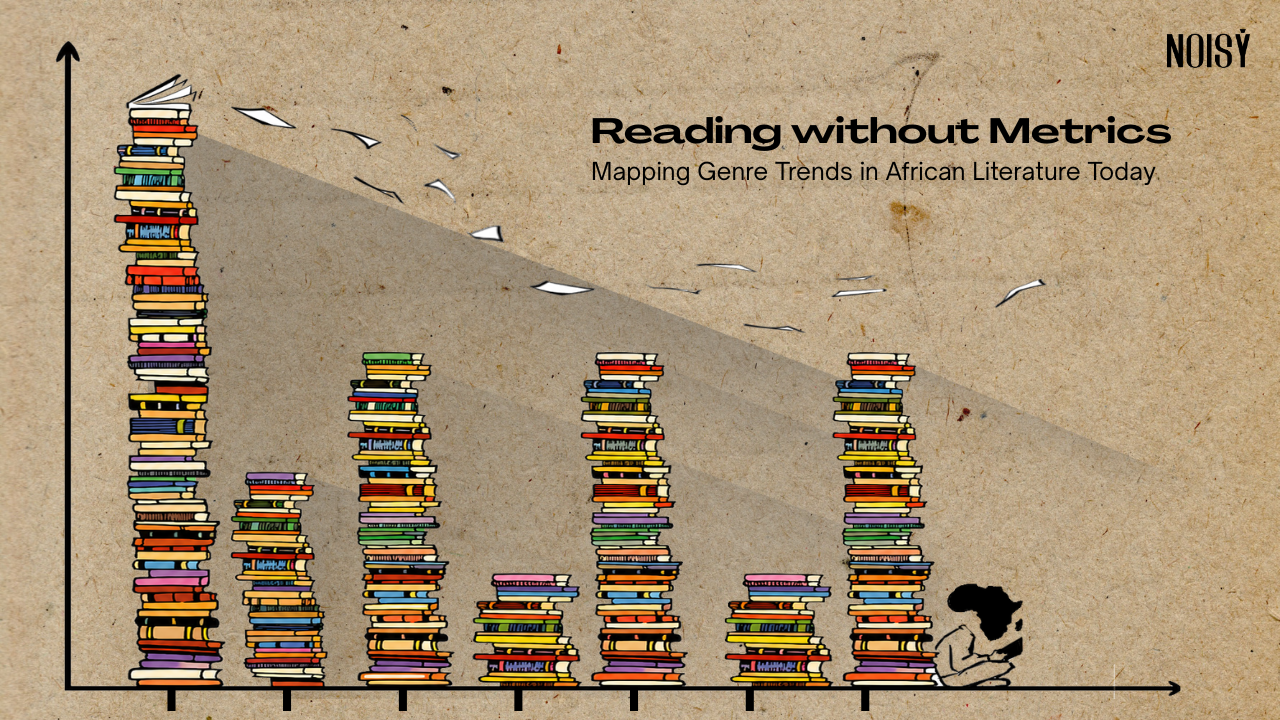
Reading Without Metrics: Mapping Genre Trends in African Literature Today
Every major industry has its instruments of measurement. The Billboard Hot 100 tells you what America is listening to. Publishing in the United States and the UK has its bestseller lists—The Times, Amazon—imperfect as they are, they function as public thermometers, telling readers and publishers what the market is absorbing.
African publishing has no equivalent architecture.
There is no centralised tracking system that aggregates sales data across any African country; no weekly chart tells you whether a debut Nigerian novel is outselling a Kenyan thriller, or if any titles have broken records. Do we know what records African titles are setting sales-wise? Other industries consider measurement infrastructure foundational, but it doesn’t exist here because no one has built systems to record and reflect African readership.
This absence creates a challenge for anyone trying to understand what Africans read. The activity of a literary culture in motion is sensed, but cannot be quantified or confirmed.
In this vacuum, the question: which genres are African readers most drawn to right now? becomes an act of forensic and emotional interpretation rather than data retrieval. The answer can be read from places other than bookshelves: festival programming, social media discourse, award longlists, diaspora recognition, from the peculiar logic of which books are reprinted and which authors are invited back to festivals year after year. These cultural signals are the available instruments, and if read carefully, they reveal a literary landscape that is more varied and commercially astute than its infrastructural limitations might suggest.
I. THE INFRASTRUCTURE GAP
What exists are islands of partial information. The most substantive though recent of these, for the Nigerian market, is the Rovingheights Bestseller List, published annually since 2023 in partnership with Open Country Mag. It compiles data from Rovingheights, one of Nigeria’s most prominent bookstores. It provides a genuine, sales-based ranking of what Nigerian readers are purchasing, but just from their stores across the country. For the third time this decade, a nonfiction title has claimed the overall top spot, establishing what the list’s compiler describes as a “new conventional wisdom“. Implying that nonfiction outsells fiction, in terms of raw volume in Nigeria.
This is a meaningful data point. But also a profoundly local one. Rovingheights represents a specific kind of reader: city-based, able to purchase traditionally distributed books, part of a socioeconomic demographic that frequents bookstores. The list’s compiler notes that publishers move more copies of their books than bookstores do.
The list is valuable. It is not comprehensive.
Brittle Paper, one of Africa’s most widely read literary platforms, publishes an annual list of notable African books. But notable, in this context, means editorially curated rather than sales-driven. This is a selection based on critical judgment, cultural significance, and breadth of representation. It signals what editors and critics believe deserves attention. Both lists are useful. Neither can tell the full story.
There is no authoritative measure of African readership. A title can appear on every notable list and win multiple awards while reaching only a narrow slice of the total reading population. The absence of integrated data means that what we perceive as “popular” is often a composite of what is institutionally recognised and what happens to be visible to the specific instruments we are using to look.
II. READING CULTURE AS DATA
Literary festivals are mirrors of reader appetite. Programming decisions at major festivals reflect what organisers believe audiences will engage with, which panels will fill rooms, which themes are generating heat in literary conversation. Festivals do not book panels for genres and books that no one cares about.
Social media communities, particularly BookTok (the reading communities on TikTok), Bookstagram (Instagram’s reader culture), and Book Twitter, are important drivers of reading behaviour globally. These organic spaces where readers recommend to readers, where a novel with no advertising budget can accumulate momentum through word of mouth, and where underserved genres find audiences that the formal literary ecosystem might ignore. For publishers and editors, monitoring what is trending in these spaces has become a form of real-time market research.
Literary awards, both local and diaspora-facing, function as prestige amplifiers. In the African context, winning or being longlisted for international awards, like the Booker Prize and the British Science Fiction Award, generates visibility that can meaningfully impact sales. Local awards, including the NLNG Nigeria Prize for Literature and various pan-African prizes, signal what the domestic literary establishment considers important, shaping critical perception and institutional recognition.
International visibility, particularly the appearance of African titles and authors on global recommendation lists, in international review publications, and in translation or adaptation deals, tells you something about which genres and titles are finding legibility outside the continent. This is an imperfect signal because international legibility and domestic popularity are not the same thing. But in a publishing ecosystem where a significant portion of infrastructure, distribution, and financing still flows through diaspora networks and international publishing houses, international attention functions as a secondary market indicator that cannot be ignored.
Taken together, these signals produce a portrait of a reading culture in active motion.
III. WHAT GENRES DOMINATE AFRICAN READERSHIP
A. THE ENDURING DOMINANCE OF LITERARY FICTION
Literary Fiction is the genre most represented in critical conversation, and most associated with the international perception of what African writing is.
Contemporary African writers continue to explore a wide range of complex themes: migration, gender and sexuality, war, trauma, healing, and the tension between tradition and modernity. These are engagements with the lived realities that define the African experience in the twenty-first century. Literary fiction’s staying power comes in part from the fact that it has made itself indispensable as a site of cultural memory and ethical reckoning.
The Rovingheights bestseller data confirms this institutional dominance. The fiction category is led by–with no guesses required–Chimamanda Ngozi Adichie’s Dream Count, one of the most globally anticipated returns to fiction, which placed first in fiction and second overall in the 2025 list’s Top 100. Every year, Adichie places the most books in the Top 100: four books in 2022, seven books in 2023, six in 2024 — and in 2025, her entire oeuvre of nine books placed across fiction, nonfiction, and children’s categories. No other author has commanded this kind of sustained, multi-title commercial presence across years.
The literary fiction shelf is populated by works that engage the full range of African tradition’s thematic concerns. A Spell of Good Things and Stay With Me by Ayobami Adebayo both placed steadily in the 2025 list, demonstrating that Adebayo’s literary profile has developed genuine commercial staying power. A Broken People’s Playlist and Tomorrow Died Yesterday by Chimeka Garricks placed in the top 25 overall. The Road to the Country by Chigozie Obioma and Necessary Fiction by Eloghosa Osunde round out a picture of a genre with both historical depth and contemporary vitality
B. THE RISE OF SPECULATIVE FICTION
Speculative fiction–fuses science fiction, fantasy, horror, and myth–centres on African perspectives in futuristic or alternative settings and is one of the fastest-growing genres in African literature. The genre’s core innovation is its insistence that African storytelling is not limited to documentation of the past or critique of the present. It reaches forward.
Speculative fiction’s ascent in the current moment is signalled by the performance of African writers at the 2026 British Science Fiction Association Awards. African writers secured nearly 30 nominations across seven categories, the most significant showing the continent has had at the BSFA in recent memory. The Best Novel category featured six African writers: Nnedi Okorafor for Death of the Author, M.H. Ayinde for A Song of Legends Lost, Nuzo Onoh for Futility, Laila Lalami for The Dream Hotel, Nkereuwem Albert for The Bone River, and Adam Oyebanji for Esperance.
The institutional legitimacy accumulating around African speculative fiction is not confined to diaspora awards. The Rovingheights data shows Children of Blood and Bone by Tomi Adeyemi placing in the Top 100 in Nigeria, a significant indicator that African fantasy finds local as well as international readers. Onyx Storm by Rebecca Yarros also placed on the list, suggesting the appetite for speculative narrative among Nigerian readers extends even to international titles too, revealing a genre hunger that local publishers can be more aggressive in meeting.
C. ROMANCE AND THE RETURN OF POPULAR READING
Romance has always had readers in Africa. What is new is its visibility, the scale at which it is now performing in the market. The Rovingheights 2025 data makes this unmistakable: Fatima Bala’s Broken: Not a Halal Love Story placed fifth overall in the Top 100 — among the top-selling books of the entire year. Adesuwa O’man Nwokedi placed three separate titles in the fiction list; Call Me Legachi, The Marriage Class, and No Perfect Love, speaking to an intensely loyal readership. Tomilola Adeyemo placed both A Very Gidi Christmas and A Nollywood Christmas in the list, suggesting that romance with explicit cultural embeddedness commands strong engagement.
What drives this resurgence? Social media has given romance an advocacy structure it previously lacked. BookTok and Bookstagram have created communities where romance readers (historically dismissed by gatekeepers as consuming something lesser) can celebrate their preferences without apology and recommend titles directly to each other, bypassing critical mediation. Festival programming has caught up: panels on African romance at events like the Ake Festival consistently draw high attendance.
The implications for publishers? Romance, by the evidence of the market’s behaviour, is one of African publishing’s strongest current growth categories deserving investment in author development, distribution, and critical attention proportional to its actual readership. The industry needs to understand where readers are now and where the momentum is pointing.
IV. CONCLUSION: MEASURING THE UNMEASURED
African readers are here, in large numbers, buying books that move through systems that leave no formally recorded trace, debating titles in WhatsApp groups, Twitter threads, and book clubs, generating no trackable sales data. The reading is happening. The culture is dynamic and evolving. The problem is the absence of measurement.
The deliberate construction of tracking infrastructure across African markets, bookseller coalitions sharing anonymised sales data, digital platforms reporting download and purchase metrics, and publisher collectives creating shared visibility into what is moving where. The Rovingheights list, now in its fourth year, is a proof of concept. It demonstrates that even partial data, consistently gathered and honestly presented, can reveal truths about reader behaviour that critical speculation can’t match. What is needed is more of it, across more cities, more languages and more market segments.
Until that infrastructure exists, the cultural signals method we currently employ is a workaround. It is the discipline of paying attention to a literary culture on its own terms, reading the signals it produces, while waiting on what a more formalised system would make legible.
African literary culture is expressing what it values in the books it buys, the authors it celebrates, the panels it fills, and the social media communities it builds around its preferred genres. The task for publishers, critics, and industry builders is to build systems adequate to understanding it, and in doing so, to better serve the readers who have been carrying it all along.
The literature is already here. The infrastructure just needs to catch up.
Sources
The Rovingheights Bestseller List 2025 (presented with Open Country Mag); the 2026 BSFA Awards longlist and results (reported via Brittle Paper and Afrocritik); the African Arguments top 20 African books of 2020; the African Literature Hub genre surveys; and critical essays on Nigerian reading culture published in academic and independent literary media.
All genre observations are based on pattern inference from available cultural signals rather than aggregate and unavailable sales data.

