

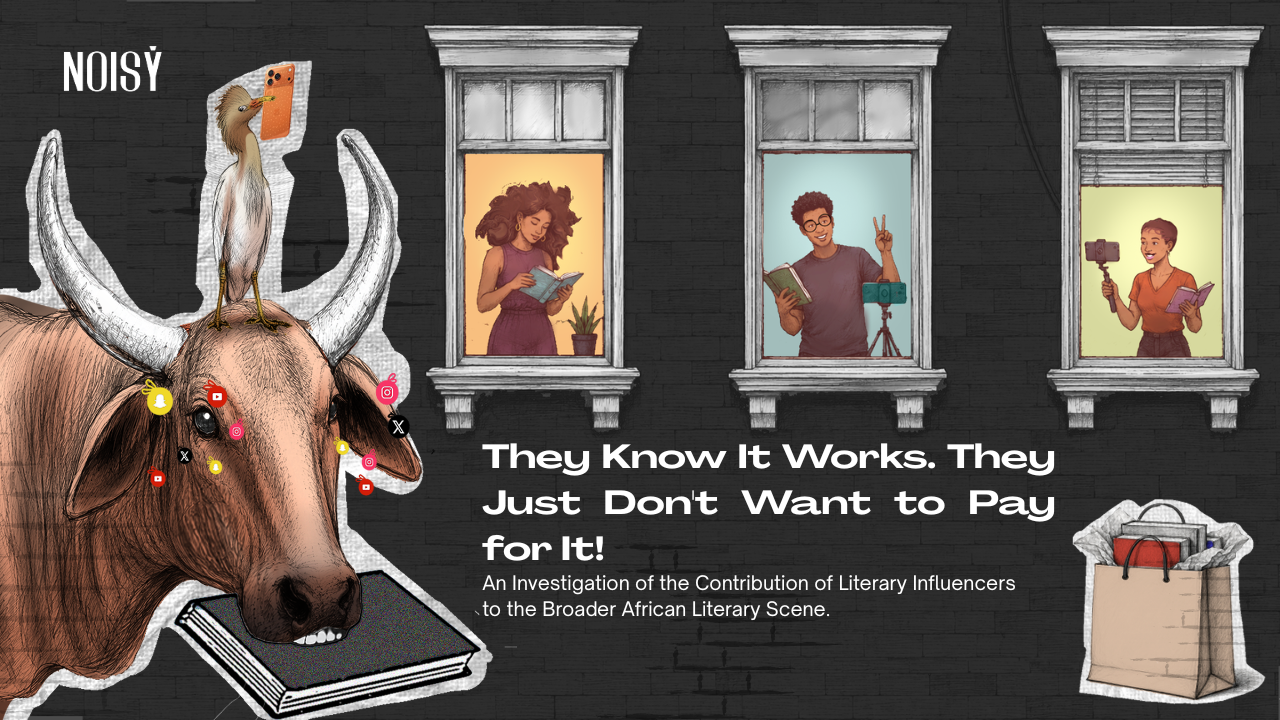
”They Know It Works. They Just Don’t Want to Pay for It”: Inside The Uneasy Economics of African Book Influencing
The influencer has become a major pillar in any modern marketing strategy. Revenue generated from influencer marketing climbed to over $30 billion globally in 2025, according to Statista, which is more than triple what it was in 2020, because brands have caught on to something simple: people trust people more because people experience products.
Nigeria has embraced that shift. According to Kantar and Statista, digital advertising crossed $340 million in 2025, and more than 65 percent of young Nigerians say they’ve bought something because a creator recommended it. Book influencing has followed the same trajectory online, but not the same economics.
Generally speaking, the Nigerian and African Literary book marketing landscape is still in its infancy. There’s usually no sufficient book marketing budget to follow a book’s release, almost no data infrastructure to track how a viral reel converts into a bought book, and none of the distribution scaffolding that lets a creator elsewhere point a follower straight to a “buy” button. Book influencers can send a title to the top of every trending page in the country and have almost no way of proving it.
The post-pandemic era witnessed a surge of book influencers within the African literary digital space, giving rise to an even more pronounced publishers and influencer relationship. Yet, beneath this seemingly productive exchange lies a more sobering reality: African publishers often lack the financial capacity to sustain the marketing life cycle required to carry a title to its full commercial potential. There is no robust or consistent marketing pipeline within the African literary ecosystem, and, similarly, book influencing lacks the structural support needed to compensate for this gap. If a relationship is built on a foundation that cannot sustain itself, one must ask: what does it ultimately become when left to evolve in such fragile conditions?
Educational texts and titles tied to school curricula make up 90% of books published in Nigeria, and Africa at large, and due to decades of underinvestment, Nigeria’s economic instability, and thin consumer spending, fiction is left competing for money and attention with almost no state support. This is the backdrop against which the Nigerian publishing ecosystem sits.
The Economics and Reality of Literary Influencing
We spoke to seven Nigerian book influencers about their relationships with publishers, how they’re compensated, and what they think needs to change. What came out of those conversations was a picture of an industry starting to reckon with its true limitations.
We asked the book influencers what the process of a collaboration with a publisher looks like, and you’ll hear the same story across the board: a DM or email outlining what a publisher wants. From there, the influencer takes over, reading the book, filming, editing, and publishing it all to an audience they’ve spent years building. That’s a marketing service by any reasonable measure. And yet, for a long time, the industry’s form of payment has been a free copy of the book. “Most of the collaborations I’ve had so far have been unpaid or product-based rather than monetary,” said one creator. Another was blunter: “I have never been offered money.” Traditional publishers, one creator noted, “typically approach with an expectation for free promotion,” while self-published and indie authors have proven far more willing to pay fairly.
Something is shifting, though, and it’s the influencers driving it. Several described a moment of reckoning, the point where the work they were putting in stopped matching a free book as payment. Micro-creators now earn ₦20,000 to ₦50,000 for single posts, while established creators can command ₦100,000 to ₦250,000 or more per campaign. “Creating quality content takes time, effort, creativity, and resources,” one said. “I believe creators should be fairly compensated.” These creators set their own terms, with contracts and deposits paid before work even begins.
There’s a particular frustration that comes up when you ask influencers how publishers treat their work. “Both the authors and publishers know it. Why else would you want to give your books away for free if the influencing is not worth it? They just don’t want to have to pay for it,” one creator said. One alone received messages from at least four publishers and over twenty authors in the first half of 2026. “The time to read and create content cannot be compensated with just the book,” she said. “I have to buy equipment to get quality content and it costs a pretty penny.” Another put it more sharply: “They love seeing their book covers trending on Bookstagram and BookTok. Yet when it comes to sitting down at the professional table, they still treat us like hobbyists who should be satisfied with a free paperback.”
What complicates the push for fair pay is that the thing publishers actually want—authentic enthusiasm—is easiest to lose the moment a relationship becomes transactional or controlling. Creators were clear that this cuts both ways: paid work doesn’t buy a glowing review, and a free book doesn’t buy silence either. “I don’t change my reviews to fit a publisher’s interests,” one creator said. “My audience trusts me because my opinions are honest. The collaborations creators pointed to as examples of what works were telling: one creator’s work with the Nigeria Prize for Literature, built on mutual trust; another’s coverage of Damilare Kuku’s titles with The Book Lady Nigeria Press, which felt like a natural extension of her content; and a creator who championed Fatima Bala’s Broken with no formal arrangement at all, simply because she loved it, and was later told the author had noticed. “It showed me that in the book industry, genuine enthusiasm can have just as much impact as a formal campaign,” she said.
This is turning into more than individual pushback. One creator described work through The Bookish Collective, an effort to standardise what it means to be a book creator in this market: “We are building an ecosystem where we pool our data, share industry knowledge, and set standard rate cards.” Another had a clear ask for publishers: “Bring us in as alpha or beta readers during the editing phase. Instead of hiring generic PR agencies who don’t actually read, hire book creators who have spent years studying the exact target audience you are trying to reach.” One offered a warning too: “If compensation does not improve, book influencers are likely to become even less reliant on publishers, choosing instead to buy and promote the books they genuinely enjoy.”
What remains less examined, however, is why this imbalance persists. Independent and self-published authors, often working with limited lists and direct financial stakes in a single title, tend to recognise the necessity of sustained marketing and are therefore more willing to allocate budget toward influencer partnerships. Traditional publishers operate under different constraints. With multiple titles on their slates, tight margins, economic instability, and rising production costs, often exacerbated by the need to print outside the continent due to limited local infrastructure, their resources may be spread too thin. In such a system, marketing can become less of a sustained pipeline and more of a series of short bursts, if it appears at all. The question, then, may not simply be whether publishers undervalue influencers, but whether the current economics of African publishing leave enough room to value them properly. If the cost of getting a book to market is already high, and returns remain uncertain, are publishers optimising for visibility, or merely for presence? With the hope that discovery will follow? And if so, where does that leave a growing class of creators who have positioned themselves as one of the few reliable engines of that discovery?
A Conversation with Amyn Bawa-Allah
Amyn Bawa-Allah, known online as Lipglossmaffia, has been building a different kind of relationship with readers and people enthusiastic about reading since 2011, long before the term existed. Her work now spans a blog Something Bookish, a Bookstagram, a podcast, two book clubs, an eight-year-old reading challenge, and live literary events.
“I found myself talking about books more than anything else online, and those were the conversations I was most excited to have,” she told us. “Each platform does something different, but they all have the same goal: helping people discover books and giving them spaces to talk about them.” Her Something Bookish Reading Challenge, now in its eighth year, has taught her that African readers are far more adventurous than they get credit for: “People tell me the challenge pushed them to pick up a genre, a country, or an author they would never have chosen on their own.” What’s struck her just as much is how global the challenge has become, with readers in other countries picking up African literature because of a prompt she wrote. “Curiosity travels really well,” she said.
On publishing houses, Amyn is direct. Engagement is improving, she thinks, but too much of it is still campaign-driven. “What I’d love to see more of are long-term collaborations instead of campaign-by-campaign thinking,” she said, pointing to her ongoing partnership with Ouida Lagos–a prominent bookstore in Lagos–where she hosts silent reading parties every second Saturday. “It’s not tied to a single book launch. It’s about creating a consistent space where reading is celebrated.” Her deliberate focus on African literature, at a time when most algorithms reward Western content, has never bothered her: “There are so many incredible African writers who deserve more visibility. Does it cost me reach sometimes? I genuinely don’t care.”
When asked if “influencer,” really captures what she does, she was honest about its limits. “It doesn’t capture the full scope. My goal has never been to simply persuade people to buy books.” She paused. “If anything, I see myself as just someone who connects people with books they’ll genuinely love. I’m a book bestie.” What she wants from publishers isn’t complicated: “The most meaningful collaborations extend beyond a single campaign. We don’t just want successful books. We want a stronger reading culture.”
What if the problem is not simply how publishers engage influencers, but how both sides have come to understand the role of marketing within the African literary ecosystem?
Amyn’s work points to an alternative: one where books are continually reintroduced through communities that invite readers in and keep conversations alive. For publishers managing multiple titles under tight financial and infrastructural constraints, marketing often becomes a question of allocation. How much can be spent, and on which book? For influencers, the response has largely been to professionalise, to demand fair compensation, and to assert their value within that system. Yet, even this evolution can remain tied to the same short-term cycle if it focuses primarily on paid campaigns attached to individual titles. The question, then, is whether both publishers and influencers are truly rethinking their approaches, or simply plastering old bandages on fresh wounds. Could publishers move toward sustained, catalogue-wide engagement rather than isolated launches? Could influencers extend their work beyond promotion into the deliberate cultivation of new readers?
But it raises the question: If the goal is to get more people to buy books, wouldn’t the reading culture need to grow? Then perhaps the challenge is to move beyond transactional visibility and toward collaborative, long-term cultural work. Otherwise, there is a risk that both sides remain caught in a loop, amplifying the same titles to the same audiences, within an echo chamber that grows louder, but not necessarily wider.
The louder question is whether the industry is building anything more durable than the next campaign.
The Larger Reckoning
Literary influencers should be fairly compensated. The labour is real; an industry that keeps asking skilled creators to accept a paperback instead of payment might be choosing convenience over fairness. But that issue doesn’t exist on its own. It sits against a backdrop of a plethora of issues plaguing the African literary scene: publishers with no dedicated marketing roadmap, no formidable governmental investment or intervention, a distribution and data infrastructure so thin that it can’t reliably prove what turns a scroll into a sale, a book market leaving fiction to fight for infrastructural attention against the voluminous demand for education texts, and an economic and political environment that makes printing, pricing, and distributing books harder than it should be.
What the moment calls for is an ecosystem that actually thrives, one where every part of African literature, from writer to publisher to bookseller to influencer, is taken seriously enough to be invested in. Fix compensation without fixing the rest, and publishers will just end up paying creators to promote within a system still starved of the infrastructure, backing, and public interest it needs to grow.
“We told the everyday African reader that it is okay to just read for fun, and we proved to publishers that there is a massive hungry market for stories that reflect our daily, contemporary experiences,” one creator said. They’ve built book clubs, podcasts, and reading challenges largely at their own expense, in time, in equipment, and in the years it takes to earn the kind of trust that makes a recommendation mean something.
Sources
Reports
UNESCO, The African Book Industry: Trends, Challenges and Opportunities for Growth (UNESCO 2025).
Mordor Intelligence, Influencer Marketing Market Size and Share Analysis (Mordor Intelligence 2025).
Krestel Digital, Nigeria’s Digital Marketing Data 2025 Report (Krestel Digital 2025).
Web/news sources
‘Nigeria Risks Losing Billions in Influencer Marketing in 2026’ Legit.ng (22 December 2025).
‘The Rise of Nigeria’s Influencer Economy’ Leadership (Abuja, 2025).
‘5 Most Amazing Influencer Campaigns from Nigeria in 2020’ Influencer Africa (12 August 2021).
‘Influencer Marketing Campaign Examples in Africa’ Dott Media House.
‘Nigerian Publishers Push Back on Textbook Ranking Policy’ The New Publishing Standard (3 May 2026).
‘Nigeria Launches 82 Locally Authored Textbooks to Stem Reliance on Imports’ The New Publishing Standard (17 March 2026).
Statistical databases
Statista, Global Influencer Marketing Market Size 2016-2025 (Statista 2025).


So good!