

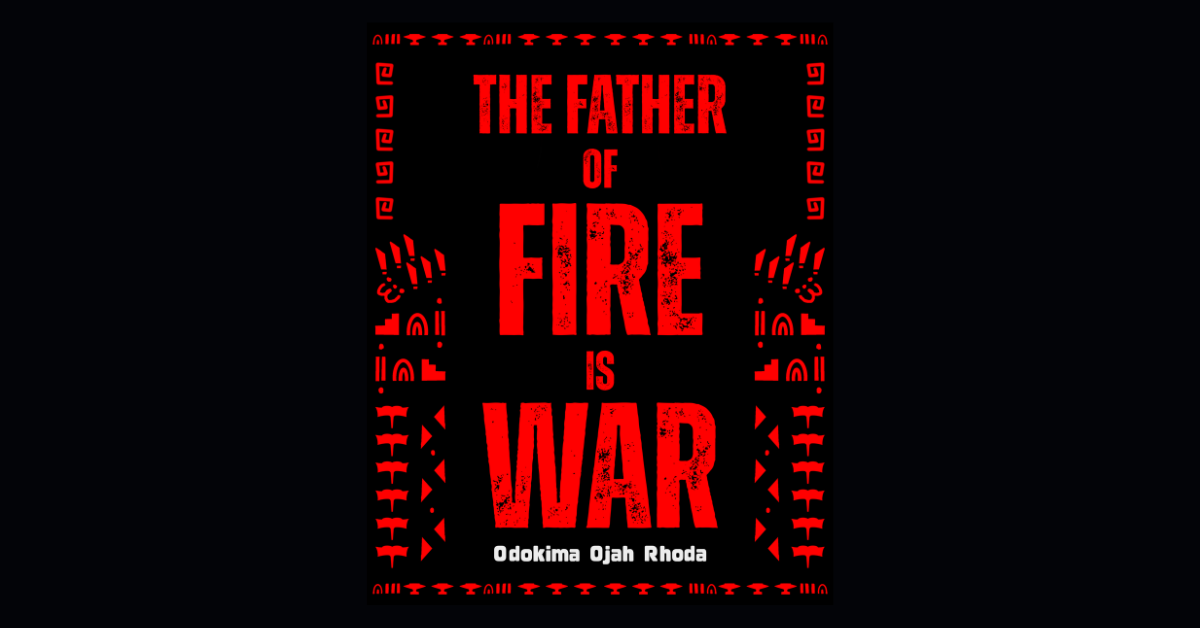
The Father of Fire is War
by Rhoda Odokima
Before I formed thee in the belly I knew thee; and before thou camest out of the womb I sanctified thee, and I ordained thee a prophet unto the nations.
– Jeremiah 1:5
PART ONE: Ìyá
They say it is during childbirth that a woman’s eyes are opened. Yèyé believes this. Because right now, on her knees, she sees.
She sees her father, the Balógun, ọmọ Èṣhù, ẹni tó ń gbé ikú wá. Her mother, beautiful as the moon, for the first time in her life. She sees her father force his knee between her mother’s thighs, then into her. She sees the child inside Yèyé forces her back to her reality. Sweat and tears mix on her face. She does not push, not yet. She screams, shutting her eyes tight, seeing again.
This time she sees her mother kneeling like she is, surrounded by midwives. She watches her own birth, and then watches her mother, still bleeding on the mat, bite her own tongue and die.
Yèyérínsá stops seeing when she opens her eyes. She feels pain greater than she ever has before. Her body feels like it is tearing apart and coming back together. She screams again. “Ìyá mi!” for the mother she had never seen, not till now. The baby is coming. Yèyé sees again.
She sees her son, a warrior like her father. If her father brought death, her son was death itself. If her father was Èṣhù’s son, her son was Èṣhù himself. He was greater than anyone that ever was. She sees songs made with his name, shrines dedicated to him. The people burned incense in his name—he was their god.
Yèyé’s vision ends and she screams one last time, pushes one last time. The midwife holds the baby and inspects him. She smiles and hands him to his mother. “Ọmọkùnrin ni,” she says. “I know,” Yèyé responds with a smile.
She holds her baby in her arms, watching him sleep. The naming ceremony is not for a few days, but she already knows his name. She smiles again at her beautiful boy. She’d borne a warrior, Ògúntọ́bí
And the women answered one another as they played, and said, Saul hath slain his thousands, and David his ten thousands.
– 1 Samuel 18:7
PART TWO: Ọmọ
The only thing you know how to do is fight. It’s all you were born to do, all you have ever done. You were born to a mother with no husband; she called you Ògúntọ́bí. You were a testament to the greatness of the god of war. Did you ever have a choice?
You did not know this, but as your mother knelt to birth you, she’d been visited by Ifá. She knew you before you’d even left her womb, adored you and feared you before seeing you. It was why whenever you fell as she trained you, she pulled you up, saying, “Tóbi, do you know who you are?” It was why at night, she whispered into your ears, that you were death, that you were fire, that you were Èṣhù. Tóbi, did you ever have a choice?
You were the best fighter in your age group, then the best warrior in the Ọba’s army, then the Balógun. You were unstoppable, Tóbi. Your mother refused to be called Yèyé, a name that linked her to the mother that never wanted her. She took Ìyá Tóbi instead, so that she became an extension of you. The things that Ifá showed her were coming to pass. Praise Ògún. Praise Ògún.
You protected your people, fighting war after war after war and winning war after war after war. So when the first songs came, they were not a surprise. They sang your name, Tóbi. To them you were not human. You could not be. If you were, you would have been injured, been hurt—something. But you weren’t. After the songs came the stories. Then finally, the shrines. This was too much for you.
So you decided to address it. You called for a meeting. You were not a god, you said. You were human, you said. They did not listen. They began to chant your name. Ògúntọ́bí. Ògúntọ́bí. Ògúntọ́bí. Ògún—
And then somehow, all you could hear was the chant. Except you heard just ‘Ògún’. And because they exalted you like a god, Tóbi, you felt like one.
War came, again. It wasn’t anything serious. You weren’t even supposed to go. Still, you went. Were you not Èṣhù? Were you not Ikú? Were you not Ògún? Did you have a choice?
Their army was bigger than you expected, you were overcome. You cut through them anyways, axe in one hand, cutlass in the other. You had never lost before, so you did not know to guard yourself more, to—
As you bleed out on the battlefield, Ifá visits you, like he did your mother forty years before. You wonder, Tóbi, if things would have been different if you’d been given a choice. You close your eyes, and see your people burn incense to a god who is already dead.
PART THREE: ORISA
Wò mí, it is not today I was born o. Neither was it yesterday. I was there before your grandfather was born, and I will be there when the children of your children die. Mo ní kẹ́ wò mí; I will never die.
I am iron that bends and does not break, metal that melts and is born again. I am the spirit of war; the blood of he who does not have my blessings feeds the earth. Do you not see that blood tastes like metal? What do you mortals even know, ehn?
There have been many who had my sign. Every terrible war that has been waged was in my name, every blacksmith owes me an offering. But I wanted a son of blood.
I found a woman, born of war and blood and death. I disguised myself and had her. I planted my seed in her. And then I waited. Ifá played a trick, showed her things no mortal should know. It was entertaining, so I did not mind. I watched, and so did the other Òrìṣàs. The boy was named for me.
Then they called my son Ikú. I swelled with pride, Ikú, with anger. They called him Èṣhù. Again, I swelled with pride while Èṣhù smoldered. He was great, and by extension he glorified me. But then, they did the unthinkable. Ah, èwọ̀!
Gbọ́ mi, a child cannot be greater than his father. A river cannot surpass the sea. Mortals know nothing! How can a son and a father be one and the same? How can a mortal be a god? Èwọ̀!
I took my blessing from my son, and sent him into war. Let the mortals remember that he is the same as them. Praise Ògún. Praise me.
It is not today I was born, neither was it yesterday. I was there before your grandfather was born, and I will be there when the children of your children die. I am a god, I will never die.


This is such a beautiful piece 🥹
Kept me enraptured till the end. Really good!